
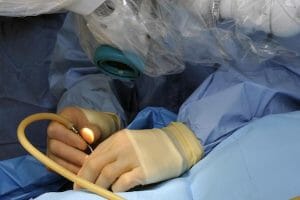
 Tonsillectomy
Surgical removal of the palatine tonsils through the mouth due to recurrent infections or sleep disordered breathing.
Adenoidectomy
Surgical removal of the pharyngeal tonsils (adenoids) through the mouth, usually to manage sleep disordered breathing, recurrent infections or persistent eustachian tube problems causing ear infections.
Sialoendoscopy
Cannulating the small natural ducts of the major saliva glands using a small camera in order to diagnose and treat saliva drainage problems often caused by stones and scarring.
Submandibulectomy
Removal of the major saliva gland under the jaw through a cut in the neck, definitively managing recurrent infections or swellings, often from stones, or tumors arising therein.
Parotidectomy
Removal of the major saliva gland in front and below the ear through a cut in the neck, often due to a mass arising therein.
Botox injections into the saliva glands
In cerebral palsy children, performed under general anesthesia into the submandibular salivary gland to control excessive drooling. In adults, performed under local anesthetic to control excess salivation.
Thyroidectomy
Either a total removal of the thyroid gland or partial removal (lobectomy and isthmusectomy) through a low front of neck incision to treat thyroid cancer, non-dangerous but large nodules/goitre or Grave’s disease.
Neck dissections
Removal of all the lymphatic structures of the neck to control or prevent cancer spreading, preserving important nerves, arteries, veins and muscles. Many types occur depending on the site and extent of cancer.
Direct laryngoscopy and biopsy, including removal of polyps and nodules
Direct examination of the larynx (voice box) and pharynx (throat) using a metal scope through the mouth, often involving taking pieces of abnormal tissue for laboratory examination, or removing nodules and polyps.
Tracheostomy
Surgical incision in the lower neck to place a tube in the trachea (breathing pipe), in order to bypass an obstructed upper airway, or to aid in ventilation and pulmonary toilet in ICU patients.
Endoscopic laser diverticulectomy
Trans-oral (through the mouth) exposure of a throat pouch that is managed by cutting the abnormal throat muscle responsible for its development with a carbon dioxide laser under microscopic guidance.
Microscopic laser resections of mouth, pharynx (throat) and larynx (voice box) tumours
Minimally invasive techniques using a microscope and the precision of a carbon dioxide laser to remove cancer completely, preserving as much normal tissue as possible.
Open approach resections of mouth, pharynx (throat) and larynx (voice box) tumours
Wide exposure approaches to remove large cancers either not amenable to minimal invasive techniques or failed chemo-radiation of head and neck cancers.
Major skin cancer resections
Removal of large skin cancers that invade into deep structures of the neck not amenable to superficial removal by a plastic surgeon or dermatologist.
Removal of benign congenital and developmental neck masses and cysts
Open neck approach to remove non-cancer masses that are present at birth or develop at a later stage of maturity as a result of embryological abnormality.